
TEMPO.CO, Jakarta – Amid the increasing turbulence in global geopolitics,
the voices of superpower nations are dominating the direction of global
policies. For example, the United States, under the leadership of
Donald Trump, has been withdrawing from various multilateral cooperation
efforts. This includes the World Health Organization (WHO), the Paris
Agreement, the UN Human Rights Council (UNHRC), and the UN Relief and
Works Agency for Palestinian Refugees (UNRWA).
Trump
has also implemented a series of measures to protect the domestic
market through high tariffs on imported goods, sparking a trade war with
China and disrupting global supply chains. Armed conflicts continue
without resolution, such as Russia’s invasion of Ukraine entering its
third year and the escalating tensions between Israel and Palestine in
Gaza and the West Bank.
The
situation has become even more complex as Iran and Israel have been
involved in a series of attacks since mid-June 2025, raising concerns of
open war in the Middle East. In Asia, anxiety is on the rise as
American and Chinese warships stalk each other in the contested waters
of the South China Sea.
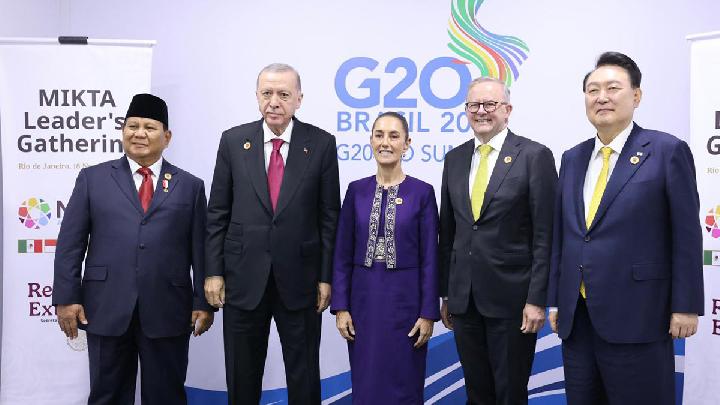
MIKTA Countries Banding Together
Amidst
such global chaos, a group of middle-power countries is seeking to
unite. Mexico, Indonesia, South Korea, Turkey, and Australia – part of
the informal forum called MIKTA
– are working to come together and define their position. They are
reiterating the importance of multilateralism and building a more
inclusive global order.
“MIKTA
can strengthen the collective voice and become a stabilizing force in
global affairs. The role of middle-power countries has now become more
crucial than ever before,” said Park Soo-deok, Charge d’Affaires of the
South Korean Embassy in Indonesia, during a discussion at the Foreign
Policy Community of Indonesia (FPCI) office in Jakarta on Thursday, June
26, 2025.
Three Agendas under South Korea’s Leadership
MIKTA
was formed in 2013 during the 68th UN General Assembly in New York.
This forum aims to strengthen inclusive international cooperation,
advance the principles of multilateralism, and bridge the interests of
both developed and developing countries.
South
Korea currently holds the chairmanship of MIKTA. During its leadership,
South Korea has set three main agendas: building global peace,
promoting youth engagement, and accelerating the achievement of the
Sustainable Development Goals (SDGs).
“This
not only reflects South Korea’s policy direction but also represents
our collective aspirations and our position as a middle-power country,”
added Park. To South Korea, MIKTA countries are considered capable of
bridging the interests of developed and developing countries in building
a more inclusive global system.
The
year before, Mexico held the leadership of MIKTA. They advocated for
democratic values, international law, and inclusive development. Alonso
Martin, Charge d’Affaires of the Mexican Embassy in Indonesia, referred
to MIKTA as a bridge between developed and developing countries.
“MIKTA
must continue to uphold multilateralism, provide creative solutions to
global challenges, climate change, finance, economy, and act as a bridge
between developing and developed countries,” he said. Alonso also
mentioned MIKTA as a complement to other global forums such as BRICS.
Mexico also initiated the strengthening of development cooperation
through the 4th MIKTA Development Cooperation Network Joint Statement.
This commitment will continue under South Korea’s leadership.
MIKTA’s Void as an Opportunity
For
Indonesia, MIKTA is a strategic forum to strengthen multilateral
diplomacy amidst the increasing vulnerability of global cooperation
principles. “We believe that MIKTA is a strategic forum to discuss
strategic issues. MIKTA should not only cover political dimensions but
also economic, social, and other issues,” said Tri Purnajaya, Director
of Development, Economy, and Environment at the Indonesian Ministry of
Foreign Affairs.
Despite
MIKTA’s grand vision, the realization of its cooperation is still
considered limited. For more than a decade since its formation, MIKTA
has yet to establish a business forum, and there have been no
initiatives for local currency transactions among member countries in
economic cooperation.
“That’s
why I think there needs to be something more concrete,” said Tri.
However, he sees this void as an opportunity. “I hope MIKTA will have a
greater desire, including in economic cooperation, trade, and
investment,” he added.
FPCI
Chairman, Dino Patti Djalal, also highlighted the importance of shared
goals in every international forum, so that they do not merely become
discussion platforms without influence. “With shared goals, movements
become faster and more meaningful, because there is a strong foundation
to remain united and move forward,” said Dino. The former Indonesian
Deputy Foreign Minister compared this with ASEAN, the European Union,
and the G7, which are strong because they have clear shared goals.
Dino added that following the withdrawal of the United States
from various international forums during Donald Trump’s leadership,
there has emerged a void that can be filled by middle-power countries.
“Middle-power countries have the capacity to play a role in
advancement,” he added.
Source: https://en.tempo.co/read/2023969/3-mikta-agendas-amidst-global-chaos-indonesia-involved